The 2010 ADA Standards for shared locker systems are specific and measurable. Here's what §225, §308, §309, §305, and §304 require — and how Arraya's kit-of-parts base system gives architects direct control over compliance.
The ADA does not require every locker to be accessible — but it does require a minimum percentage to fully comply, and that compliance depends almost entirely on decisions made at specification time, not in the field.
The most common compliance failures — openings below 15″ AFF, door hardware requiring pinching or twisting, insufficient clear floor space — are all specification-layer problems. They cannot be fixed after fabrication without significant rework.
Arraya's kit-of-parts architecture was developed with ADA compliance as a design constraint from the start. The base system, zone heights, and door hardware options are all configured to give architects the levers they need to specify a fully compliant accessible locker without compromise to the design intent.
Review the Standards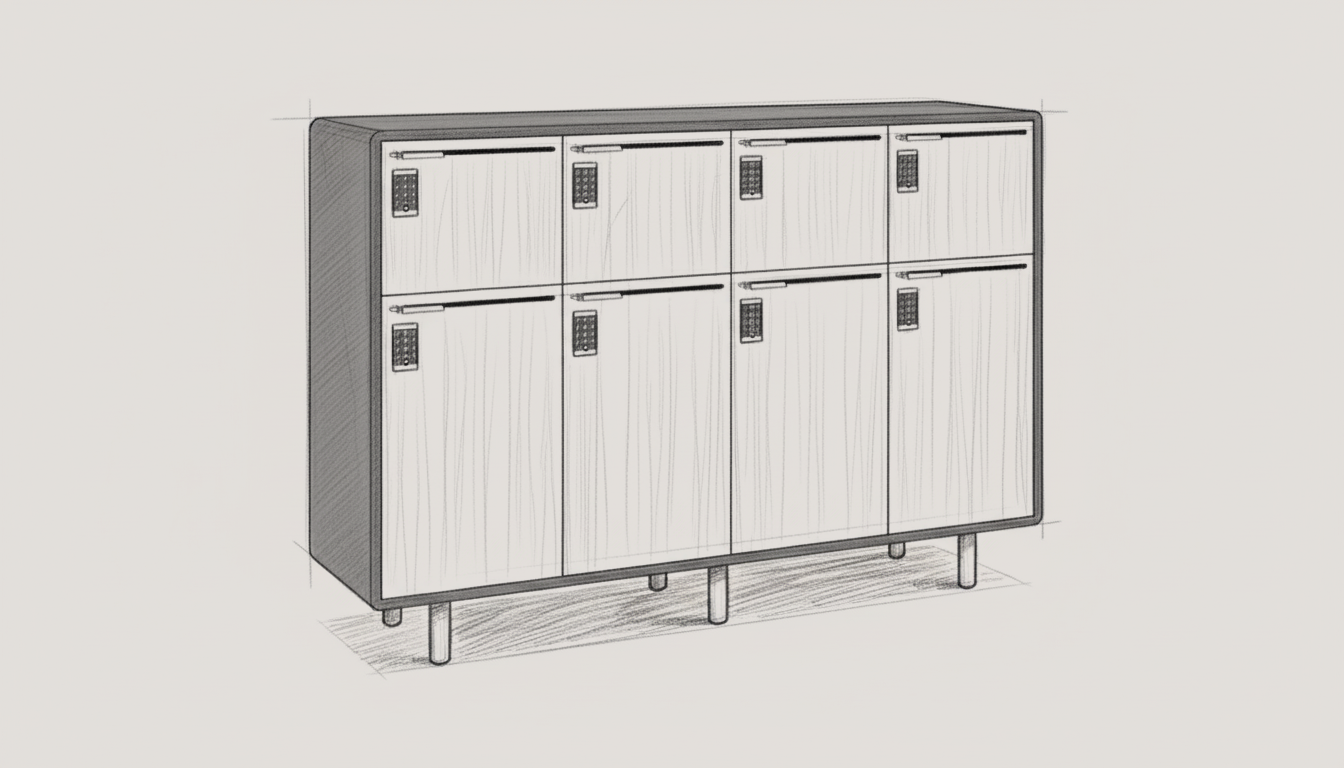
Each standard addresses a different physical dimension of accessibility. All five apply to any locker installation that must include accessible units.
Where lockers are provided, at least 5% of each type shall comply with ADA storage requirements, with a minimum of one accessible locker per type. "Type" is defined by function and location — day-use lockers in one room and assigned lockers in another are each counted separately.
≥5% or 1 minimum, per type, per locationAll operable parts — lock, latch, hook, interior shelf — on accessible locker openings must fall within 15″ to 48″ AFF (above finished floor). For side reach, the maximum is 48″ AFF; for forward reach over an obstruction, limits vary by obstruction height. The bottom of the accessible opening must clear 15″ AFF minimum.
15″ min – 48″ max AFF, all operable partsAccessible openings must be operable with one hand, without tight grasping, pinching, or twisting of the wrist, and with no more than 5 pounds of force. This standard applies to the lock, latch, and any interior hooks or hanging hardware on accessible locker openings. Push-to-open doors on spring hinges must be verified against the 5 lbf limit.
≤5 lbf / one hand / no pinch or twistA 30″ × 48″ clear floor space must be provided at each accessible locker opening — centered on the opening, unobstructed, and positioned to allow a person using a wheelchair to approach either forward or side-facing. This clear space must be factored into aisle width planning during layout, particularly in high-density locker configurations.
30″ × 48″ clear floor space at each accessible openingAccessible locker areas must provide either a 60″ diameter circular turning space or a T-shaped turning space (60″ × 60″ T-turn). This is a room-level design requirement that affects overall locker room or alcove layout. Aisle widths between facing banks of lockers must be coordinated with this requirement.
60″ diameter turning circle or T-turn in accessible areasState and Local Codes: California Title 24, New York City Local Law 97 accessibility amendments, and other state codes may impose stricter requirements than federal ADA minimums. Always verify applicable local accessibility codes at project outset. HAMILTON's project team can provide jurisdiction-specific guidance for projects in regulated markets including New York City.
The reach range zone is the vertical band within which every operable part on an accessible locker opening must fall. The base system determines where this zone starts.
Any operable part above 48″ AFF — including locks on tall top-row openings — is outside the compliant reach range. On a standard 3-high bank with no base, top-row locks can exceed 60″ AFF. Specifying a 2-high configuration, or restricting accessible designations to lower-row openings, resolves this issue.
All operable parts on accessible designated openings must fall within this range. Arraya's zone heights and base selection are configured to maximize the number of openings that naturally fall within this window. A storage base raising the unit 8″–10″ brings even bottom-row locks well above the 15″ minimum.
On floor-mounted locker banks, the bottom row of a standard unit can place the lock face at 10″–13″ AFF — below the minimum. This is the most common ADA compliance failure in locker specification. The solution is a raised base. Arraya's storage base addresses this directly.
Arraya's base options give architects precise control over where the lowest opening begins. Base selection is made at the specification stage — not in the field. For accessible-designated banks, the storage base is the only reliably compliant choice.
| Base Type | Approx. Floor Lift | Bottom Row Lock (3-high) | §308 Status |
|---|---|---|---|
| Storage Base | ~8–10″ | ~18–23″ AFF | Compliant |
| Leg Base (Open) | ~6–9″ | ~16–22″ AFF | Non-Compliant |
| Plinth Base | ~3–4″ | ~13–16″ AFF | Non-Compliant |
| Mobile Base | ~4–5″ (casters) | ~14–18″ AFF | Non-Compliant |
Exact lock face heights depend on locker module height and opening layout. Confirm with HAMILTON's specification team for project-specific ADA calculations. "Verify" indicates dimensions are close to the §308 threshold — field verification recommended.
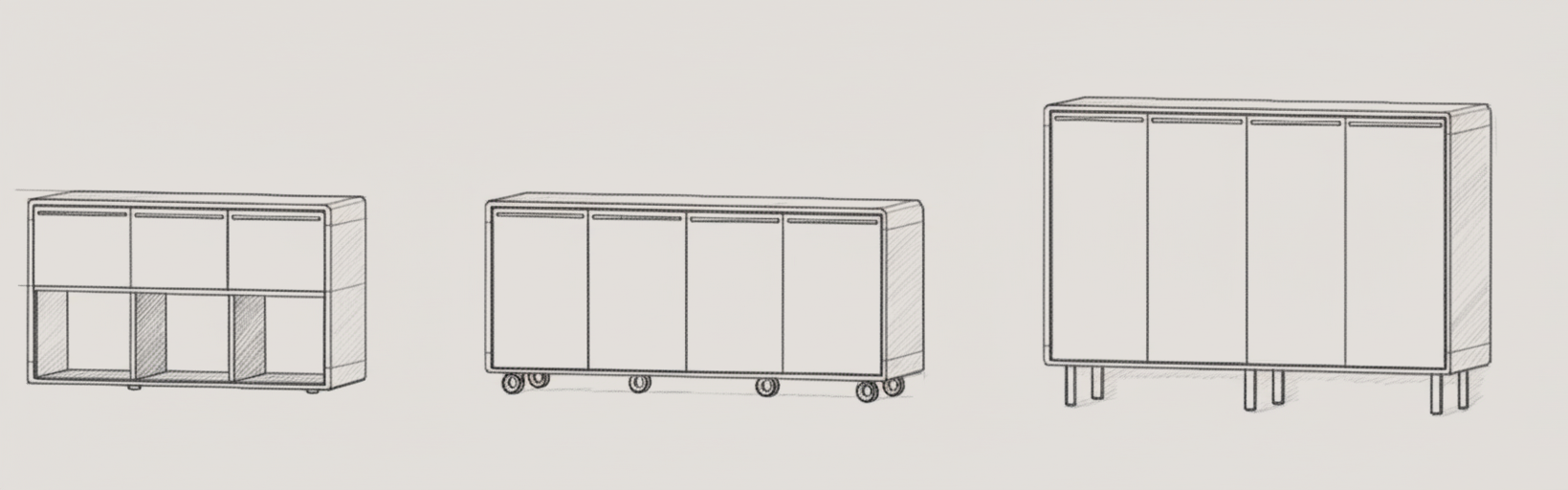
Arraya base options — the storage base reliably raises the bottom row above the §308 15″ AFF minimum for 3-high configurations.
A HAMILTON-delivered AIA course using Arraya as the reference product. One learning unit + one HSW credit. Available for in-person lunch-and-learn delivery at your firm.
Use this checklist at specification time. Most ADA locker failures are preventable at the specification stage — not correctable in the field.
Each of these failures has appeared in completed projects. All are preventable at specification time.
Floor-mounted locker banks almost always place the bottom row lock below the §308 minimum of 15″ AFF. This is the most common locker ADA violation in the field.
On a 4-high or tall 3-high locker bank, the top-row lock face can reach 60″–68″ AFF — well above the §308 maximum. Accessible designations applied to top rows without height verification are non-compliant.
Traditional padlock hasps, combination dial locks, and coin-operated key locks all require grasping, pinching, or twisting — a direct §309.4 violation on accessible openings.
A standard locker room bench placed directly in front of accessible lockers can eliminate the required 30″ × 48″ clear floor space. This is a layout-level failure, not a product failure.
Facilities that provide multiple locker types across multiple locations sometimes apply the 5% calculation to the total locker count rather than to each type per location — resulting in fewer accessible units than required.
Tight locker alcoves designed for footprint efficiency can fail to provide the §304 60″ turning space. The alcove reads as a dead-end for wheelchair users if the aisle is under 60″ wide or lacks a T-turn area.
HAMILTON's specification team provides project-specific reach range calculations, accessible locker quantity guidance, and full specification support for qualified projects.