Hospitality & Entertainment
Hotels, casinos, and resorts run nonstop across three shifts. Your locker infrastructure should be built for it — electronic access, automatic temp-staff assignment, and real-time visibility into every locker bank.
The Challenge
Hospitality operations run at full speed around the clock. Traditional locker systems weren't built for it — and the friction shows up at every shift change.
Employees arriving for a new shift can't find available lockers. Outgoing staff linger. The locker room becomes a chokepoint that delays the entire floor operation at its most critical moments.
Casinos, hotels, and resorts are regulated environments. Shared locker access — two employees using the same locker across shifts — creates unacceptable security and compliance exposure with no record of who accessed what and when.
Without usage data, operations managers can't tell which lockers sit empty all day or which banks are overwhelmed at peak hours. Capacity problems fester until they become complaints — and opportunities to right-size get missed entirely.
The Solution
HAMILTON locker cabinets are engineered for the specific demands of 24/7 multi-shift environments — from casino floors to full-service resort back-of-house. The electronic access system is selected by the property or their locker distributor.
Employees access their locker electronically — badge tap, mobile credential, or other method determined by the property's chosen access system. Electronic access is significantly faster than traditional combination or keyed locks. No keys to lose, no combinations to forget, no lockouts at the start of a shift.
Temporary and seasonal employees receive a locker automatically when added to the system. When their shift or season ends, the locker is released without any manager intervention — no lock cut-offs, no manual reassignments, no "orphaned" lockers eating up capacity.
Managers see locker status, utilization rates, and shift-by-shift access patterns from any device. Every access is time-stamped and logged. Know exactly which lockers are available, which are camping, and where to expand before the problem surfaces on the floor.
Monarch Casino & Resort — Black Hawk, Colorado
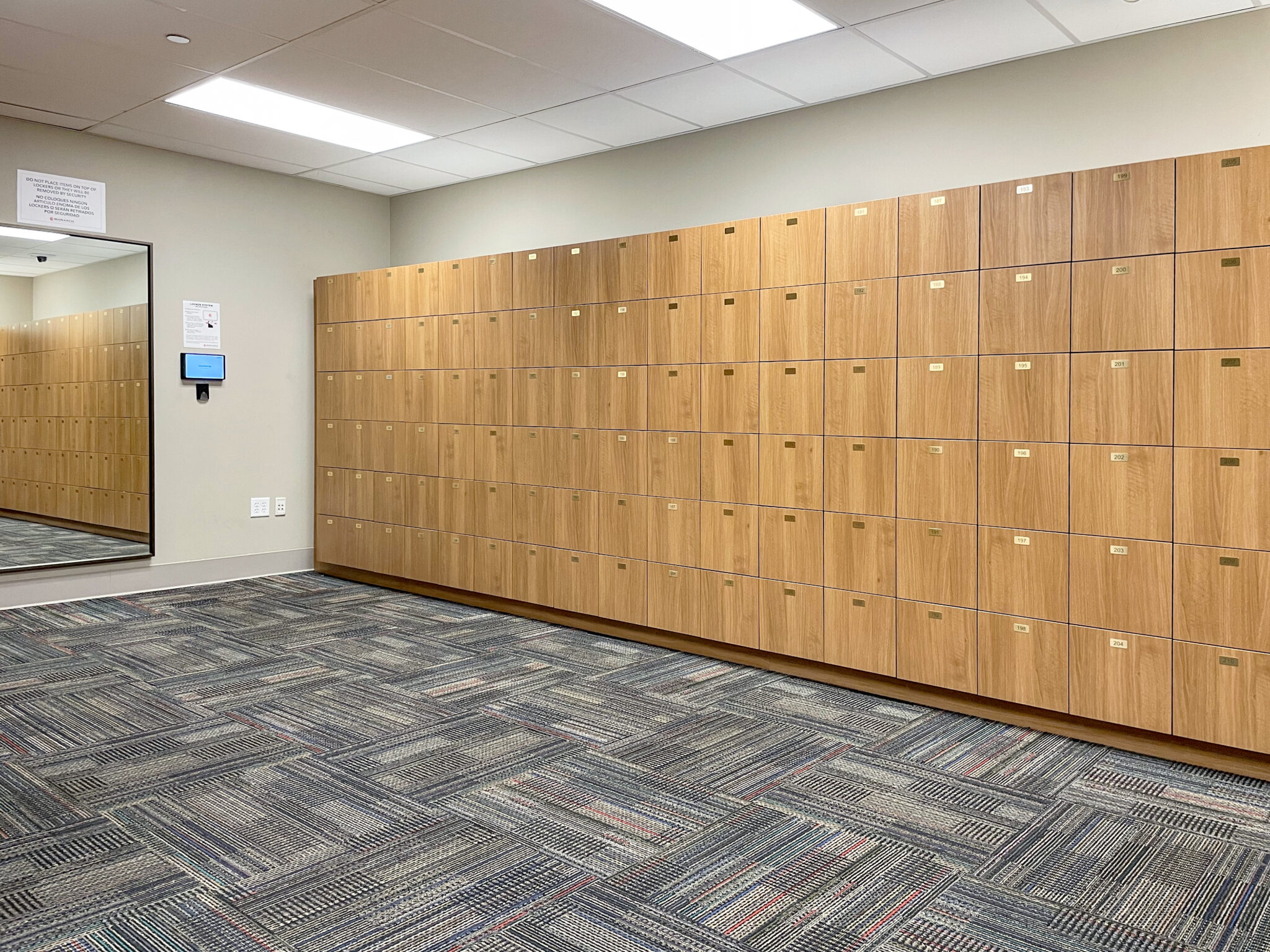
Monarch Casino operates 24/7 with three overlapping shifts and a workforce that includes a significant proportion of temporary employees. Their legacy locker system had become a daily friction point: shift changes caused delays, shared access created security exposure, and management had no data on actual usage patterns.
HAMILTON manufactured and installed 330 smart locker cabinets across the employee locker room as part of a smart locker program with electronic access integration. Every employee — full-time, part-time, and temporary — received individual electronic access credentials. Temporary staff assignments became fully automated: lockers activate on clock-in and free up on clock-out.
In the first 90 days, the system logged 162,000 locker accesses — an average of 493 per locker, with the top-performing units surpassing 900 accesses each. Shift changes that previously caused bottlenecks now run without disruption. Security and compliance teams gained a complete, time-stamped audit trail for every access event.
"The smart lockers have transformed how we manage our employee operations. Shift changes are seamless, and our staff feels secure knowing their personal belongings are protected."
— Monarch Casino Management
Usage Intelligence
Monarch Casino's smart locker access data revealed exactly when and how employees were using lockers across the 24-hour cycle — insights that would be impossible with traditional lock hardware.
Steady and reliable. Morning prep and setup drive consistent locker usage without overwhelming peaks — the system absorbs demand smoothly at the start of the day.
The highest-traffic shift. Overlapping schedules and peak-hour staffing drive the heaviest locker demand. The Afternoon Rush (3–5 PM) alone accounts for 26,574 accesses — handled without a single bottleneck.
Lower staffing levels after hours, but the system stays fully operational. Night shift employees get the same frictionless experience as the morning crew — 24 hours a day, seven days a week.
Business Impact
Smart lockers aren't a facilities upgrade — they're an operational investment with a measurable return. Monarch Casino's 330-locker deployment generated savings across three distinct categories, documented over 90 days and annualized.
Maintenance costs dropped as predictive alerts caught hardware issues before they became service calls. Administrative overhead nearly disappeared as automated assignment eliminated daily locker management tasks. And the productivity gains from faster access — 15 seconds saved per interaction, multiplied across 330 employees and three shifts — compound quickly over a full year.
These figures are based on Monarch Casino's actual deployment data and industry-standard labor costs. Your operation's savings will vary, but the structure of the return is consistent across hospitality environments with multi-shift workforces.
*Based on 330-employee, 3-shift operation. Individual results will vary.
Who We Serve
HAMILTON locker cabinets are deployed across the full range of hospitality and entertainment operations — anywhere employees work shifts, share space, and need secure personal storage. The access technology is selected by the property or their locker distributor.
24/7 operations with overlapping shifts and a mix of permanent and temporary staff. Individual credentials and time-stamped access logs support the compliance and security requirements of regulated gaming environments.
Housekeeping, front desk, F&B, and maintenance teams all sharing back-of-house locker areas. Smart assignment ensures the right capacity is available at each shift change without manager involvement.
Seasonal staffing spikes demand a system that scales without adding administrative burden. Temporary employees receive automatic locker assignments that expire cleanly at the end of their contract period.
Event-day staffing that can triple or quadruple baseline headcount. Dynamic locker assignment handles surges without pre-planning or physical lock management on the day of the event.
Crew environments with rotating deployment schedules require a locker system that reassigns spaces automatically as crew rosters change between voyages — with no manual intervention from HR or facilities teams.
High-turnover staff environments where traditional combination locks become an ongoing administrative burden. Smart lockers eliminate code management entirely and give managers real-time visibility into locker room occupancy.
Frequently Asked Questions
How do smart lockers handle shift changes in a 24/7 hospitality operation?
HAMILTON locker cabinets are engineered for round-the-clock multi-shift environments. With an electronic access system in place, employees access lockers using their badge, phone, or other credential — no keys, no combinations, no delays. The access platform supports flexible assignment so temporary or part-time staff receive a locker automatically at clock-in and the locker is freed when they clock out. At Monarch Casino, shift changes that previously caused locker room bottlenecks now run seamlessly, with the afternoon peak handling over 26,500 locker accesses with zero staff intervention.
Can hotel and resort employees use their existing ID badge to access smart lockers?
Many electronic access systems used in hospitality smart locker programs are compatible with standard employee ID badge formats. The specific credential compatibility depends on the electronic access platform the property or their locker distributor selects — HAMILTON manufactures the locker cabinet and engineers it to receive the access hardware. Credential integration, badge compatibility, and mobile credential support are all determined by the chosen access system.
What ROI can a casino or hotel expect from switching to smart lockers?
Based on Monarch Casino's deployment of 330 lockers across three shifts, the system generated over $31,000 in documented annual savings: approximately $6,600 in reduced lock maintenance costs, $1,825 in eliminated administrative overhead, and $22,591 in employee productivity gains from faster locker access during shift changes. Additional benefits from reduced employee turnover — staff consistently cite secure, frictionless storage as a satisfaction driver — are harder to quantify but consistently mentioned by hospitality HR teams.
How does the system handle a high proportion of temporary or seasonal staff?
Smart locker programs with flexible assignment mode are specifically designed for hospitality operations with high temp-staff turnover. Temporary employees receive a locker assignment automatically when added to the system; the locker is released when their assignment ends. Managers never need to manually reassign lockers, chase down keys, or cut off forgotten padlocks. Programs can also support ADA locker designation, ensuring accessible positions are always reserved appropriately regardless of daily occupancy changes. HAMILTON builds the locker cabinet infrastructure; the access platform handles the assignment logic.
What locker materials and finishes are available for hospitality back-of-house environments?
HAMILTON builds hospitality locker systems in high-pressure laminate (HPL) and solid-surface materials engineered for heavy-use environments. Standard finishes include woodgrain laminates (like the warm walnut tones specified at Monarch Casino), solid colors, and custom brand-matched options. All hardware is commercial-grade stainless. HAMILTON also offers GREENGUARD Gold certified material options for properties pursuing LEED or sustainability certifications. Every system is backed by Hamilton's lifetime guarantee.
Smart locker and storage systems for offices, headquarters, and hybrid workplaces across the US.
Explore Workplace Solutions →Secure, self-serve parcel pickup for hotels, residential buildings, and mixed-use properties.
See Parcel Locker Solutions →How Fordham University deployed 288 HAMILTON smart locker cabinets — and what campuses can learn from the utilization data.
See the Fordham Case Study →Tell us about your property — number of employees, shifts, and any existing locker infrastructure — and we'll design a system sized for your operation.