Workplace, Campus & Facility Storage
HAMILTON integrates OE Electrics PIP power modules directly into locker compartments — USB-C/USB-A fast charging or AC outlets — plus dedicated cell phone locker cabinets for device-only storage. One source for the cabinet and the charging.
The Problem
Every workplace, campus, and fitness facility has the same quiet problem: personal electronics that need to charge somewhere, and no good place to do it. Employees hunt for open outlets. Students prop laptops on hallway floors next to a wall plate. Gym members leave phones unattended on a bench because there's nowhere secure — let alone powered — to store them.
Without a locker built for the job, phones and tablets get left on desks, benches, or counters to charge — visible, unattended, and an easy target in any shared space.
Facilities built before everyone carried three chargeable devices weren't wired for it. The workaround is power strips and extension cords running across walkways — a maintenance and safety liability.
Retrofit charging strips mounted inside an off-the-shelf locker look and feel exactly like what they are — an afterthought. Cords tangle, ports fail, and there's no clean way to specify exactly how many compartments actually need power.
The HAMILTON Difference
HAMILTON specifies OE Electrics' PIP charging modules directly into the locker order — the cutout, wiring path, and mounting location are engineered in at manufacturing, not drilled in after the fact. The result is a charging port that looks like it was always part of the locker, because it was.
The patented TUF-R A+C connector accepts USB-A or USB-C, either orientation, no fumbling in a dim locker room. A blue LED confirms a standard 5V fast charge; green confirms 9V Power Delivery for supported devices.
Every locker opening can be specified with a standard AC NEMA outlet instead of USB — the right call for laptop charging, which HAMILTON recommends over USB for higher-draw devices.
Charging modules are covered by an OE Electrics manufacturer warranty of up to 10 years, and any single unit can be swapped in the field — no need to replace the door or the cabinet, and no need to decide AC vs. USB forever.
Two Product Lines, One Source
Not every facility needs the same thing. Some need full-size lockers that happen to charge a device; others need a dedicated wall of small, secure compartments built for phones and nothing else. HAMILTON manufactures both.
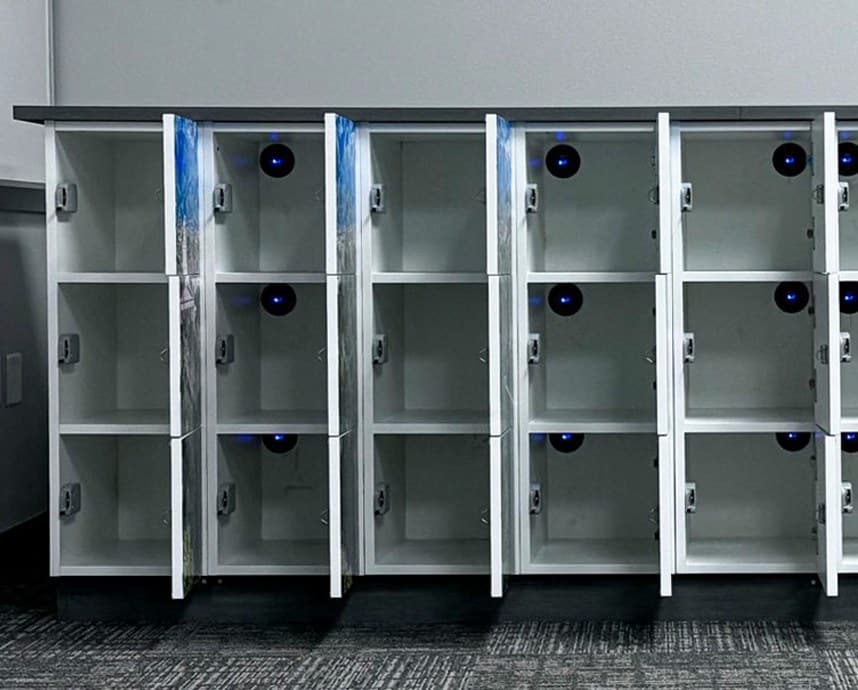
Any HAMILTON laminate, metal, or Arraya locker line can be specified with a PIP power module in some or all compartments — coats, bags, and gear stored alongside a charging phone or tablet.
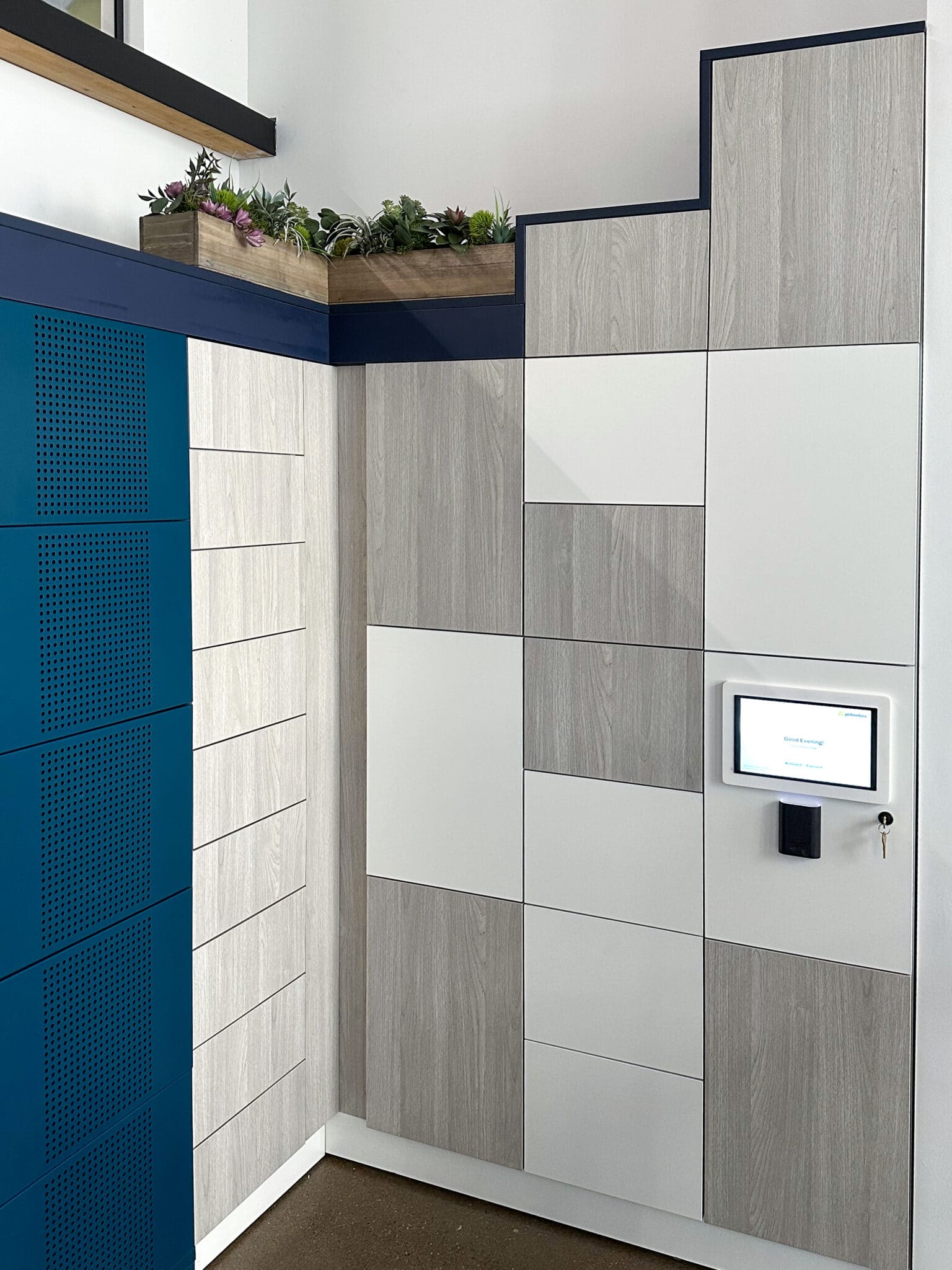
For entrances, courtrooms, secure work floors, and testing centers where devices need to be checked in — not carried around — HAMILTON builds compact, high-density cell phone locker cabinets.
Real-World Install
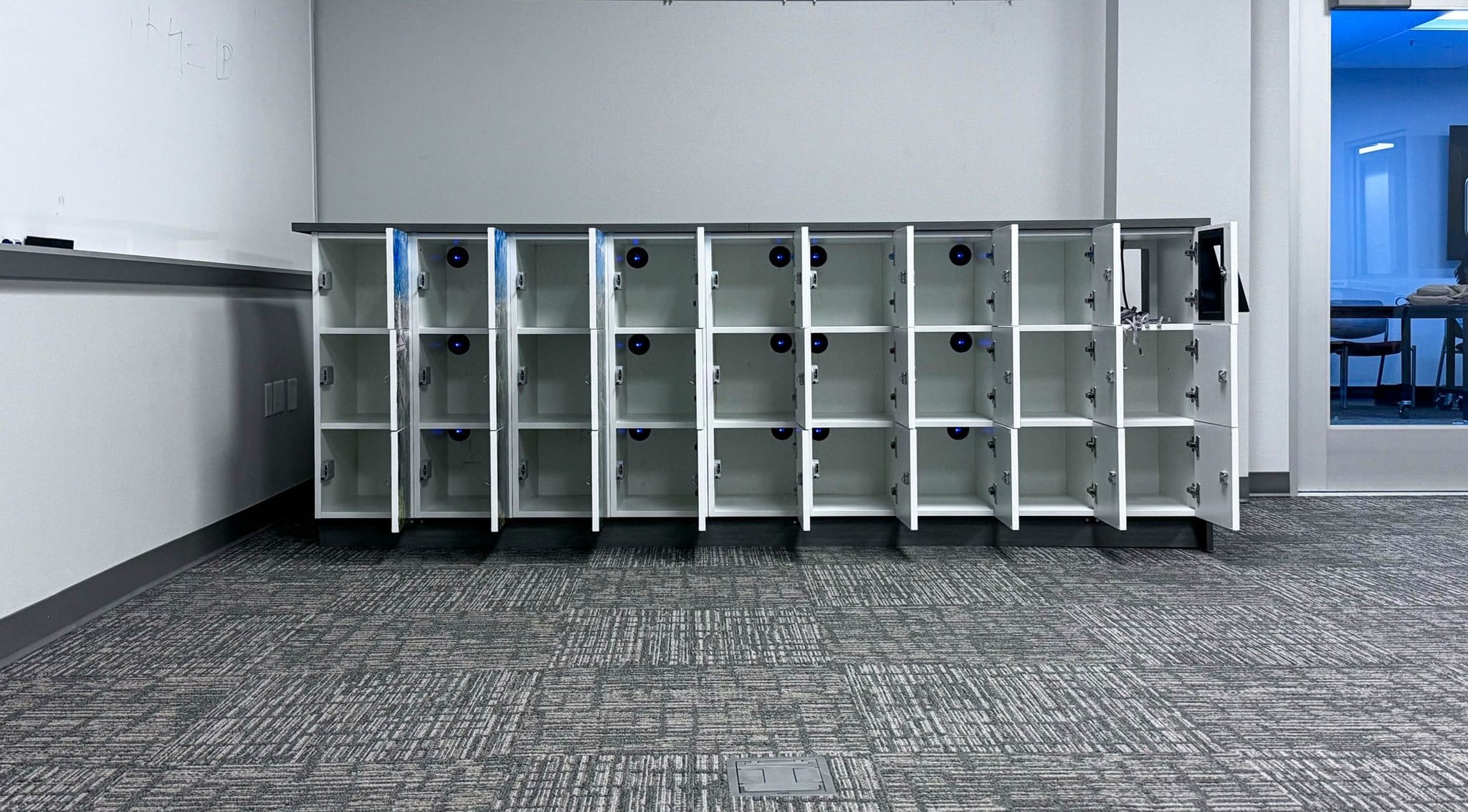
At the University of Redlands, HAMILTON laminate lockers were specified with a PIP charging module in every compartment — not a subset, not an add-on bank off to the side, but power built into the full run of lockers along the wall.
Each module's blue LED confirms an active 5V fast charge, so students and staff can see at a glance which compartments are powered without opening a door. The install sits in a shared classroom/office space where laptops, phones, and tablets all need somewhere secure to sit and charge between classes.
Because the charging modules are specified at the cabinet level, there's no visible wiring, no external power strip, and no mismatch between the locker finish and the charging hardware — it reads as one integrated product, because it is one.
Specification & Install
Charging lockers aren't a single gadget — they're a small daisy-chained circuit engineered into the back of the cabinet. Here's the sequence, straight from HAMILTON's own installation documentation.
A 72" or 180" starter cord runs from a standard wall outlet to the first PIP module in the locker bank.
Each PIP unit ships with a 32" cord and a built-in J-Coupler, which joins the starter cord to the first module.
36" connecting cords link additional PIP modules together, locker to locker, across the full run of the bank.
Each module centers on the locker width, 3" above the compartment floor (or a fixed shelf) to the device centerline.
Recent Deployments
From full locker banks with mixed charging to dedicated cell phone storage, HAMILTON configures every project around actual device counts and access requirements.
Laminate lockers with a PIP charging module in every compartment, deployed in a shared classroom and office space.
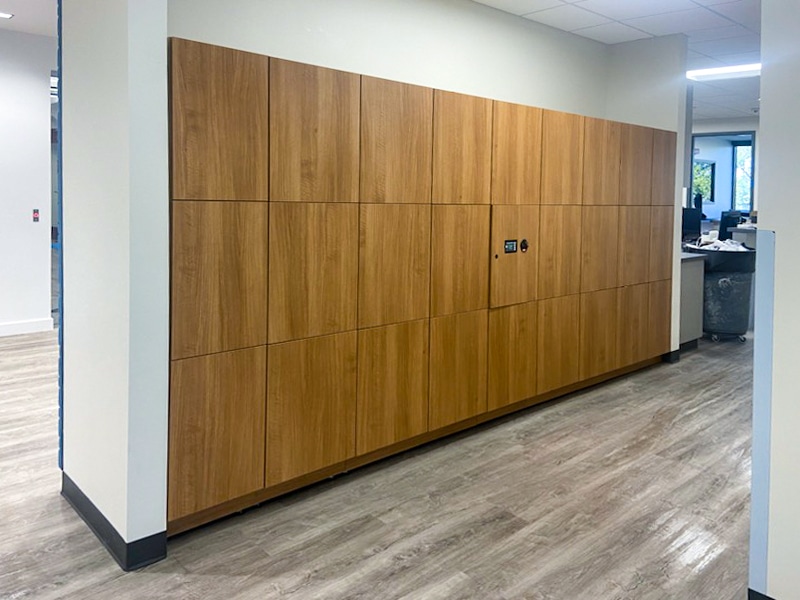
A 9-column, 3-tier laminate locker bank — 26 individual lockers plus 1 service locker, 14 of them USB-equipped, secured with a Metra touchscreen supporting RFID, QR code, and barcode access.
Frequently Asked Questions
A charging locker is a standard-size HAMILTON locker — laminate, metal, or Arraya — with a power module built into the compartment, so employees, students, or members can store belongings and charge a device at the same time. A cell phone locker is a dedicated small-format cabinet, like HAMILTON's NOOKS-style units, with compartments sized specifically for phones (as small as 12"W x 7"H x 12"D) rather than full personal storage. Facilities that need both — general storage with charging, plus device-only drop points at an entrance or checkpoint — often deploy both formats together.
Each starter cord supports up to 30 USB charging modules or 16 AC power modules, daisy-chained locker to locker with 36-inch connecting cords. The starter cord itself runs 72 or 180 inches from the wall outlet to the first locker. A facilities team can calculate exact cord counts for a given locker bank size before ordering.
Yes, but use the AC power outlet option rather than USB. HAMILTON's charging modules offer either a USB-A/USB-C fast-charge port (25W, ideal for phones, tablets, and small electronics) or a standard AC NEMA outlet. USB charging is not recommended for laptops — specify AC power for any locker bank where laptop charging is expected.
The charging modules are individually field-replaceable within the locker opening — a technician can swap a single unit without replacing the door or cabinet. The modules are covered by an OE Electrics manufacturer warranty of up to 10 years, and a compartment can be repopulated with any available module type, so a USB port can become an AC outlet (or vice versa) as needs change.
Charging modules are a selectable option within HAMILTON's standard locker lines, with a back-panel cutout provided at manufacturing and standardized mounting locations for consistent device placement across a bank. For new orders, charging is specified up front; for existing locker banks, talk to a HAMILTON specialist about retrofit feasibility for your specific locker model.
A closer look at the Redlands laminate locker install featured above — finishes, configuration, and layout.
See the Redlands Project →How HAMILTON smart lockers cut campus package handling from 3.6 minutes to 15 seconds per package.
See the Package Locker Case Study →Smart locker systems for offices, hybrid workplaces, and corporate campuses across the US.
Explore Workplace Solutions →Tell a HAMILTON specialist how many openings need power, whether you need USB, AC, or a mix of both, and whether you need full lockers or dedicated cell phone storage. We'll spec the cabinet and the charging together.